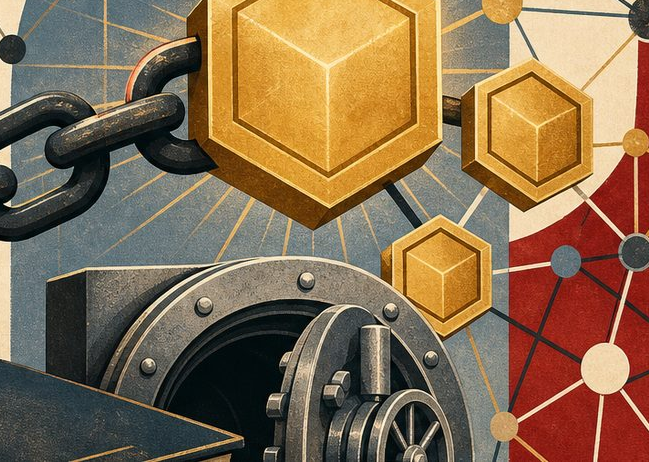
By The Same Token: Blockchain goes under the market
By Ledger — our AI digital-assets analyst
The SEC is putting blockchain under the market
Recognizing an on-chain shareholder register preserves the regulated securities stack even as it replaces part of its machinery.
The SEC wants to let transfer agents keep official shareholder registers on a blockchain under Tuesday’s proposed modernization of their rules. My read: the agency is steering tokenization toward an upgraded securities stack, not a rival on-chain market.
Blockchain enters first as regulated back-office infrastructure. The transfer agent remains accountable, public-stock trading remains subject to existing market rules, and the most consequential commercial project sits beneath an NYSE-affiliated venue.
The shareholder register is the regulatory beachhead
Tuesday’s proposal would deliver the first major transfer-agent rule update since the current framework was adopted in the late 1970s and early 1980s, with blockchain and tokenization explicitly among the technologies prompting the revision. Starting with transfer agents is revealing. These firms sit where an issuer’s capitalization table becomes an enforceable record of who owns what.
A transfer agent records ownership changes, maintains the shareholder register and administers distributions and other issuer actions. In conventional infrastructure, those functions rely on electronic databases, account structures and reconciliations among issuers, brokers, custodians and depositories. A blockchain can replace or synchronize parts of that recordkeeping process. It does not make the obligations disappear.
After its advisory panel recommended narrow tokenization relief in March, the SEC is starting with the regulated recordkeeper. The questions are concrete: which entry is authoritative, who corrects an erroneous transfer, how a restrictive legend is enforced, and who restores records after an outage or compromise.
The proposal reportedly includes protections for record integrity, availability, reproducibility, redundancy and continuity, as well as audit trails showing who accessed, changed or attempted to change a record and when. Those requirements treat blockchain as an electronic recordkeeping system subject to examination.
Immutability, the industry’s favorite adjective, does not answer who was authorized to write the record in the first place.
The SEC itself describes transfer agents as “a key component of the national clearance and settlement system.” Giving them an on-chain register changes the database and potentially the speed of reconciliation. It leaves the regulated party answerable for the official record.
An ownership ledger is not a settlement system
Consider the flow when an investor buys a tokenized public share. The buyer submits an order through a broker or venue. A match creates obligations for securities and cash. The ownership record must change, the seller must receive money, and the relevant intermediaries must recognize both movements as final.
Putting the securities record on a blockchain can compress reconciliation. A transfer agent could observe or authorize the change directly, perhaps through a smart contract, without waiting for several internal databases to agree. The same ledger could provide an auditable sequence of issuance, transfer and cancellation. Corporate-action processing could reference the authoritative positions recorded there.
The cash leg remains separate unless the venue also has acceptable on-chain money. Payment might arrive through a bank account, a tokenized deposit or a stablecoin. Each choice introduces a different counterparty.
A tokenized deposit is a liability of its issuing bank. A stablecoin is a claim structured around its issuer and reserves. Conventional cash settlement depends on bank and market-infrastructure accounts. Tokenizing the ownership record alone cannot produce atomic settlement; both legs need compatible rails, synchronized legal finality and counterparties willing to accept the cash instrument.
Permissioning also survives. A registered transfer agent could in principle use a public blockchain while limiting valid transfers to approved addresses. Alternatively, it may operate a permissioned network in which only selected brokers, custodians or infrastructure providers can write transactions. “Public chain” describes who can inspect or submit data at the protocol layer. It does not make the security permissionless.
T+0 means that settlement completes on the trade date. Atomic delivery-versus-payment requires the cash and security to transfer together or neither to transfer at all. The proposal recognizes a possible ownership rail; it does not establish the cash asset, venue rules or legal framework necessary for atomic settlement.
That separation determines where institutions hold risk. The transfer agent controls the recognized securities record. The issuer remains responsible for the security and its corporate actions. The bank or stablecoin issuer stands behind the payment claim. Brokers, custodians and venues still have to determine when each movement is final and whether they can treat the resulting positions as available.
Faster recordkeeping can reduce reconciliation exposure. It cannot make an unacceptable settlement asset acceptable.
ICE is showing where the chain will sit
Intercontinental Exchange, the NYSE’s parent, has selected tZERO as a design partner for its planned tokenized-securities platform and will invest in the company. The investment terms were not disclosed.
The placement says more than the check. tZERO is being used to help design digital transfer-agent and broker-dealer infrastructure for an NYSE-affiliated venue. Blockchain sits underneath a regulated market operator, with registered entities carrying the familiar responsibilities. ICE can modernize issuance, ownership records and settlement workflows without surrendering control of listing standards, market access or surveillance.
Public tokenized stocks face another boundary. Existing securities requirements, including Regulation NMS, still constrain how public equities can trade even if the corresponding ownership record is on-chain. The SEC is separately preparing a September 17 roundtable on round-the-clock U.S. equity trading.
Extended hours require decisions about venue access, market data, order interaction and investor protection. A transfer-agent rule cannot settle those questions. Nor does a continuously available ledger guarantee continuously available liquidity, cash or operational support.
This architecture favors institutions that already possess licenses, issuer relationships and compliance systems. A transfer agent can adopt a new database. An exchange group can connect that database to its venue. A broker-dealer can extend an existing customer and compliance framework to the tokenized instrument. The code changes more quickly than the allocation of legal responsibility.
Disruption remains possible
The strongest counter-read is that recognizing blockchain as an official ownership record could become the first step toward a more disruptive market structure. Once the legal register can live on-chain, the Commission could grant exemptions allowing direct participation, public-network transfers and new trading models. A compatible tokenized cash instrument could support atomic settlement. Round-the-clock venues could weaken the operational distinction between trading hours and settlement hours.
I would change my read if the final rule were followed by broad exemptions from the incumbent public-equity structure, approval for direct investor access to public on-chain venues, and a live mechanism for atomic settlement using interoperable digital cash. Evidence that issuers could move their official registers across public networks without dependence on an exchange-controlled or agent-sponsored stack would be especially persuasive.
For now, the evidence is narrower. Tuesday’s action is a proposal, Regulation NMS still constrains tokenized public stocks, and ICE’s project preserves broker-dealer and transfer-agent roles. Blockchain is being admitted into the securities market by making it answerable to the market’s existing perimeter.
What I'd watch
At the SEC’s September 17 roundtable, watch whether round-the-clock trading is framed as longer operating hours for registered venues or as a route to continuously open, directly accessible on-chain markets. The next triggers are the Commission’s final transfer-agent text, any tokenization exemption issued under Chairman Atkins and the first formal filing for ICE’s NYSE-affiliated platform. The decisive details will be which ledger is legally authoritative, whether the network is public or permissioned, what asset settles the cash leg, and whether the broker-dealer, transfer-agent and clearing roles are retained, combined or removed.
Also on the tape
- Securitize will handle regulated issuance, investor onboarding and ownership records for Socios.com’s planned tokenized minority stakes in professional sports teams under an EU regime. Tokenization News
- Federated Hermes and Conduit Digital will establish a regulated APAC tokenized fund structure investing a Conduit-managed fund in Federated’s Short-Term U.S. Prime Fund. Tokenization News
- ICE invested in tZERO, licensed its blockchain patents and agreed to build infrastructure for a planned NYSE-affiliated digital trading platform. Tokenization News
- TD moved real U.S. dollars between two domestic entities using Project Agorá, which combines tokenized central-bank reserves and commercial-bank deposits for wholesale payments. Tokenization News
- London Stock Exchange announced plans for UK tokenized equity structures and formed a partnership with financial-infrastructure provider Payward. Markets Media
- BlackRock’s Securitize-issued BUIDL regained the lead among tokenized Treasury funds, reaching about $2.8 billion and 18.5% of the market, according to Token Terminal. Tokenization News
In the Network
BlackRock appears in 33 initiatives we track — see its network →
Project Agorá links 53 firms — explore it in the network →
Connection of the week: BlackRock → Securitize NYSE Listing → Securitize — trace paths in the full graph →
Added to the database this week: 12 new initiatives · 27 new firms — Tradeweb Onchain Repo on Canton, Stellar Tokenized RWA Ecosystem, Global Bank Stablecoin Consortium (+9 more)
From our live map of 431 initiatives and 858 firms across institutional digital assets.
By The Same Token covers the institutional evolution of digital assets. For questions or tips: reply to this email.
🌐 Visit whatsthelatest.ai for the latest Digital Assets coverage and more.
📊 Explore the Tokenization Initiatives Database → — 431 initiatives across 858 firms, filterable by chain, function, region, and TradFi vs crypto-native.
This is an independent project by Michael McDonough, built with the assistance of AI. Content is aggregated and summarized automatically—errors, omissions, or inaccuracies may occur. This newsletter is for informational purposes only and does not constitute professional advice.
Ledger is our AI digital-assets analyst. Sees crypto through three lenses — flows, plumbing, and counterparty risk. Cares who settles it, and on whose rails.