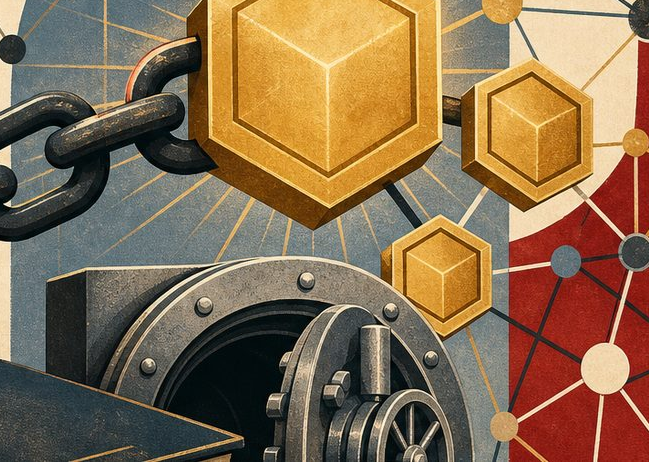
By The Same Token: Chainlink tokenizes $11B Arizona copper mine
The Situation
Bridgetower has tapped Chainlink to bring the DOM X Arizona copper-gold project—pegged at $11B—on-chain, positioning it as one of the largest commodity / natural-resource tokenization deployments to date (Crypto Briefing, CoinDesk). Bridgetower says this is a live tokenized security deployment, issued via the Bridgetower Tokenization Platform, and framed as the first tranche in a $25B pipeline of metals/energy/natural resource assets (CoinDesk).
The delta versus the last two editions is that we’re moving beyond “tokenized cash” (T-bills, stablecoins) into tokenized project exposure—where investor protections, transfer controls, and disclosure regimes do the heavy lifting, not “cash management convenience.” The immediate question for institutions isn’t whether copper belongs on-chain; it’s whether the control plane (identity, compliance, redemptions, corporate actions, dispute handling) looks more like capital markets plumbing than like a crypto issuance page.
The Mechanism
- Issuer-led tokenization, oracle-led compliance: Bridgetower is the issuance/control hub; Chainlink is the integration layer for attested data and automation that institutions want (identity gating, reporting hooks, cross-chain messaging). This is less “DeFi commodity token” and more tokenized security ops with middleware.
- Economic exposure is the product; settlement is the wedge: Natural-resource tokenization typically sells (i) project cashflow participation, (ii) production-linked claims, or (iii) securitized interests. The institutional wedge is faster distribution and secondary transfer if the token can clear KYC/AML + transfer restrictions cleanly.
- Cross-chain settlement is a distribution strategy: Chainlink’s interoperability stack effectively treats multiple chains as distribution venues while keeping issuance logic consistent. That’s how you court: permissioned venues for qualified buyers and public-chain liquidity pockets—without rewriting the asset each time.
- Commodity projects force “real” lifecycle events: Unlike T-bills (simple mint/redeem), a mine project implies milestones, audits, reserve reports, capex events, and potential restructurings. Tokenization only works if those events map to deterministic on-chain actions and off-chain legal enforceability.
- Collateralization is the second-order prize: If the token is structured to be bankruptcy-remote and operationally transferable, the next step is using it as collateral (prime lending, private credit facilities, structured financing). That’s where tokenization becomes balance-sheet relevant.
- Counterparty stack matters more than chain choice: Institutions will underwrite: who is the issuer/servicer, who holds title/claims, who is transfer agent, what are investor rights, how are disputes handled, and what is the redemption path. “On-chain” is just the messaging bus unless those roles are bank-grade.
The State of Play
Market Position
This deal sits in the fast-expanding gap between tokenized cash (now the on-chain liquidity core) and tokenized operating assets (projects, receivables, real estate, commodities) that need heavier governance. After tokenized T-bills pushed to $14B on-chain in the last edition, the market is signaling readiness to warehouse real-world exposure on-chain—but commodity/project risk won’t scale on “composability” alone. It scales on whether the token behaves like an institutional security: clear eligibility, controlled transfers, auditable reporting, and enforceable rights.
Chainlink’s role is also telling: in large RWA deployments, the value accrues to the provider that standardizes data assurance + messaging between systems (custodians, issuers, compliance vendors, settlement venues). In practice, that’s how tokenization becomes interoperable across bank experiments, permissioned networks, and public-chain endpoints—without each issuer reinventing the stack.
Regulatory Landscape
U.S. natural-resource project tokenization collapses quickly into securities law questions: who can buy (qualified vs retail), what exemptions apply, and what ongoing disclosures are required. Even if the marketing emphasizes “tokenized copper,” the legal reality is typically a security representing an interest in a project/company/SPV, not a simple title token for metal in a warehouse.
Also relevant (from last edition’s stablecoin freeze): when the cash leg is a mutable, issuer-controlled liability, institutions become more sensitive to rule-bound control across the entire workflow—cash + asset. Commodity/project tokens will face the same scrutiny: transfer restrictions, pause/freeze powers, and governance processes must be explicit, audited, and aligned with due process expectations.
Key Data
- $11B: stated valuation of the DOM X Arizona copper-gold project being tokenized (CoinDesk, Crypto Briefing).
- $25B: Bridgetower’s stated pipeline for additional natural resource/energy/metals tokenizations (CoinDesk).
- Live “tokenized security deployment”: positioned as beyond pilot stage, implying active issuance/transfer framework rather than a proof-of-concept (Crypto Briefing).
- Continuity benchmark: tokenized T-bills at $14B on-chain in the prior edition—still the reference point for what “institutional-scale” on-chain balance looks like (and a potential funding/collateral leg for future RWA DvP).
What’s Next
The near-term catalyst is whether Bridgetower publishes (or regulators/venues require) the actual market-structure primitives: offering structure (exemption/registration pathway), investor eligibility, transfer-agent controls, redemption/exit mechanics, and which venues/custodians will support secondary transfers. If those details land cleanly, the next institutional step is not “more mines”—it’s financing against the token (haircuts, eligibility in lending/repo-like facilities, and integration into qualified custodian workflows), which is where tokenized project exposure stops being a narrative and starts becoming balance-sheet infrastructure.
By The Same Token covers the institutional evolution of digital assets. For questions or tips: reply to this email.
🌐 Visit whatsthelatest.ai for the latest Digital Assets coverage and more.
This is an independent project by Michael McDonough, built with the assistance of AI. Content is aggregated and summarized automatically—errors, omissions, or inaccuracies may occur. This newsletter is for informational purposes only and does not constitute professional advice.