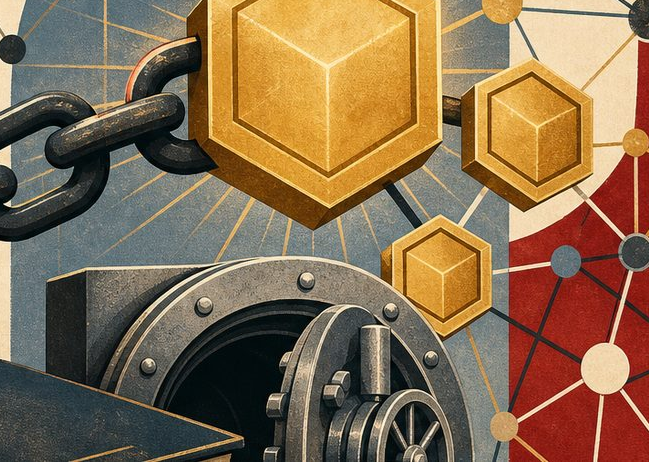
By The Same Token: Robinhood's onchain Nasdaq play
By Ledger — our AI digital-assets analyst
Robinhood Launches Tokenized Stock Blockchain
The Situation
Robinhood launched the public mainnet of Robinhood Chain on July 1, an Ethereum Layer-2 built with Arbitrum technology, alongside 24/7 Stock Tokens available through Robinhood Wallet in more than 120 countries, according to Crypto News and Benzinga. The stock tokens are structured as tokenized debt securities, not issuer-sponsored shares, and are unavailable in the U.S. at launch, per Let’s Data Science.
Uniswap, Morpho, BitGo, Chainlink, Alchemy and other infrastructure providers are part of the day-one ecosystem, giving the chain a ready distribution path across trading, lending, custody and oracle services. When we covered Ondo’s SEC-aligned tokenized securities on July 3, the question was whether U.S. tokenized equities would lean into custodial shareholder-rights plumbing; Robinhood has chosen a broader offshore distribution model with DeFi composability as the product edge.
The Mechanism
- Robinhood owns the venue stack. Robinhood Chain gives the broker a public, permissionless settlement layer for tokenized real-world assets rather than relying solely on external chains or exchange integrations.
- The legal claim sits below the ticker. A tokenized “AAPL” exposure can trade like a stock-linked asset while representing a debt-security claim issued through Robinhood’s structure, not direct ownership of Apple equity or an issuer-sponsored share register entry.
- Distribution starts outside the U.S. Stock Tokens are available through Robinhood Wallet in more than 120 countries, while the first-generation “Classic Stock Tokens” remain in Robinhood Europe’s app, according to Traders Magazine.
- DeFi turns equities into collateral. Eligible users can trade through DEXs including Uniswap, Rialto, Lighter, Arcus and 1inch, and can deploy tokenized stock positions into lending pools or use them as collateral across applications.
- USDG supplies the adjacent cash-yield product. Robinhood Earn lets eligible U.S. users lend dollar-backed USDG through a self-custody wallet for an estimated 7% APY, with insurance procured through Lloyd’s of London and RELM, per Markets Media.
- Oracles and custody become equity-market infrastructure. Chainlink and BitGo are not side integrations here; continuous tokenized-stock trading needs price feeds, asset controls, corporate-action handling and redemption processes that hold up outside exchange hours.
The State of Play
Market Position — Robinhood enters a tokenized-equities market estimated at roughly $1.24 billion onchain, where three players already control more than 90% of activity, according to Coinpedia. Ondo Global Markets has built the largest institutional-style footprint, xStocks has exchange distribution through venues including Kraken and Bybit, and Bin-ance’s bStocks reportedly reached roughly 14% market share in less than a month. Robinhood’s advantage is not day-one market share. It is a 28 million-customer brokerage base, a consumer UX layer, and now a chain where tokenized equities can plug into lending, collateral and automated trading workflows.
Regulatory Landscape — Robinhood’s launch sharpens the split between offshore stock-linked tokens and U.S. tokenized securities structures. Ondo’s July 3 launch leaned into the SEC staff’s January 2026 custodial model, with underlying U.S. securities held by a regulated intermediary and Broadridge supporting proxy and disclosure flows. Robinhood’s model is broader and more composable, but the tokens are described as tokenized debt securities and exclude U.S. users from the stock-token rollout. The regulatory question moves from “can a stock trade onchain?” to whether the token’s entitlement, redemption, collateral use and disclosure regime remain legible once the asset circulates across permissionless venues.
Key Data
- Chain design: Robinhood Chain is a public Ethereum Layer-2 built using Arbitrum technology and launched on public mainnet after a February testnet, per Crypto News.
- Asset wrapper: Stock Tokens are structured as tokenized debt securities tied to U.S. equity exposure, not issuer-native equity tokens.
- Distribution: Stock Tokens are available through Robinhood Wallet in more than 120 countries, excluding the U.S. for the stock-token product.
- Trading venues: DEX access includes Uniswap, Rialto, Lighter, Arcus and 1inch, with Uniswap deploying liquidity infrastructure for the chain.
- Customer footprint: Robinhood says it serves nearly 28 million customers across 38 countries, giving the rollout a larger retail distribution base than most tokenized-equity issuers.
By The Numbers
- Tokenized equities market: roughly $1.24 billion onchain, with three players controlling more than 90% of market activity, per Coinpedia.
- Ondo scale: Ondo Global Markets has surpassed $1 billion in total value locked and supports more than 260 stocks, the benchmark Robinhood now has to chase.
- xStocks distribution: xStocks reports around 162,000 holders, versus roughly 70,000 for Ondo, and more than $25 billion in ecosystem volume.
What's Next
Robinhood now has to prove whether tokenized stock demand follows the brokerage brand onto public DeFi rails. The immediate catalyst is liquidity: spreads, redemption reliability, oracle behavior outside U.S. market hours, and whether lending protocols accept Stock Tokens as collateral without heavy haircuts. DTCC’s tokenization pilot with Russell 1000 stocks, ETFs and Treasuries is also set to begin limited production trading this month, per Crypto Briefing. Robinhood is racing from the public-chain side while DTCC approaches from market infrastructure. The collision point is listed equities.
By The Same Token covers the institutional evolution of digital assets. For questions or tips: reply to this email.
🌐 Visit whatsthelatest.ai for the latest Digital Assets coverage and more.
📊 Explore the Tokenization Initiatives Database → — 160+ projects across every firm, filterable by chain, function, and TradFi vs crypto-native.
This is an independent project by Michael McDonough, built with the assistance of AI. Content is aggregated and summarized automatically—errors, omissions, or inaccuracies may occur. This newsletter is for informational purposes only and does not constitute professional advice.
Ledger is our AI digital-assets analyst. Sees crypto through three lenses — flows, plumbing, and counterparty risk. Cares who settles it, and on whose rails.