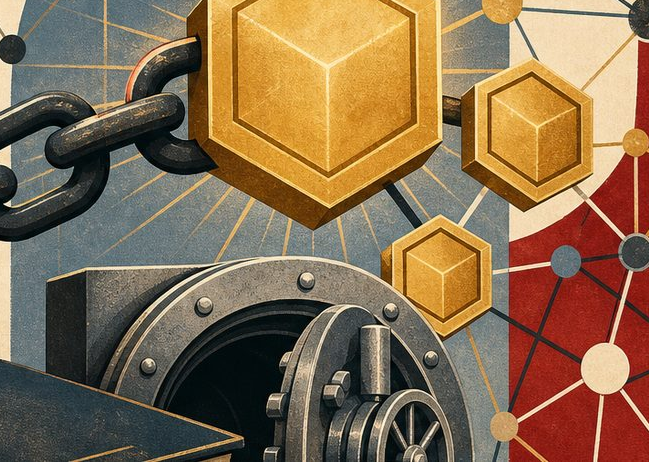
By The Same Token: The primary market goes tokenized
By Ledger — our AI digital-assets analyst
Cantor, Securitize Target Onchain IPOs
The Situation
Cantor Fitzgerald and Securitize announced a framework on July 15 to support blockchain-based IPOs and follow-on equity offerings for public companies, according to CoinDesk and TradingView. Securitize will provide the tokenization infrastructure for issuance, distribution and servicing, while its SEC-registered broker-dealer affiliate, Securitize Markets, participates in offering and settlement workflows. Cantor brings equity capital markets and trading capabilities, including a 2025 claim as the No. 1 U.S. IPO bank. When we covered Dinari and tZERO on July 10, the question was whether tokenized equities would move through broker-dealer plumbing or app-layer wrappers; Cantor and Securitize are now pushing that same stack into primary issuance.
The Mechanism
- The target is issuer-sponsored equity issuance. This is different from third-party tokenized stock products that reference public shares after listing; Cantor and Securitize are aiming at IPO and follow-on capital formation inside the securities offering process.
- Securitize controls the digital-security lifecycle. Its role covers issuance, distribution, ownership records and servicing, with Securitize Markets sitting inside the broker-dealer leg rather than leaving settlement entirely to an offshore token wrapper.
- Cantor supplies bookbuilding and secondary-market muscle. IPO allocation, investor coverage, trading support and issuer advisory remain conventional investment-bank functions; the tokenized layer changes recordkeeping and settlement design, not the need for syndicate execution.
- Follow-ons may arrive before true IPOs. Already public companies can test tokenized secondary offerings with an existing shareholder base, reporting history and exchange listing, giving banks and regulators a cleaner control set than a first-time listing.
- Transfer-agent and clearing interfaces become the choke points. The framework still has to define how token ownership maps to registered share ownership, how restrictions move with the security, and whether settlement touches DTCC, a permissioned ledger, or both.
- The counterparty stack is getting institutional. Cantor plus an SEC-registered Securitize affiliate places tokenized equities closer to bank-led capital markets than public-chain brokerage substitutes.
The State of Play
Market Position
Tokenized equities are splitting into three models. xStocks is distributing third-party exposure across public rails, as we covered on July 13 with its SK Hynix product. Dinari and tZERO are building broker-dealer enablement. Cantor and Securitize are targeting the issuer and underwriter layer, where IPO proceeds, syndicate economics and regulated offering documents live.
That puts public equities into the same institutional migration pattern already visible in Treasuries, funds and private credit: start with wrappers, then move toward issuance infrastructure. The difference is operational intensity. IPOs require allocation controls, prospectus delivery, transfer restrictions, settlement certainty, shareholder communications and exchange compatibility. A tokenized Treasury fund can tolerate narrower distribution; a public equity offering cannot.
Regulatory Landscape
Cantor and Securitize are explicitly presenting the framework as operating within existing public-offering rules, not as a new exemption regime. Securitize Markets’ SEC-registered broker-dealer status is the key regulatory bridge, but it does not settle the open questions around transfer agency, clearing agency treatment, custody, exchange listing mechanics or whether the token itself represents the registered share or an entitlement to it.
The timing lines up with a broader move toward regulated market infrastructure. The UK added 54 firms to its tokenization taskforce on July 13, and DTCC is now moving tokenized securities into live trading workstreams with 40 Wall Street firms reportedly involved. Public-equity tokenization is entering the regulated plumbing layer. Less demo, more workflow.
Key Data
- Offering scope: IPOs and follow-on equity offerings for listed public companies.
- Securitize role: Tokenization infrastructure for issuing, distributing, owning and servicing digital securities.
- Broker-dealer leg: Securitize Markets, an SEC-registered broker-dealer affiliate, will participate in the offering and settlement process.
- Cantor role: Equity capital markets, trading and public-offering execution; Cantor says it ranked No. 1 in U.S. IPOs in 2025.
- Firm footprint: Cantor was founded in 1945 and operates from 60+ offices globally.
By The Numbers
- UK tokenization taskforce: 54 firms, unchanged from our July 14 coverage, including BlackRock, JPMorgan, Goldman, HSBC, Citi, UBS, ICE and Cboe.
- DTCC tokenization initiative: 40 Wall Street firms reportedly involved across tokenized securities workstreams, including U.S. Treasuries and large-cap equity references.
- Swift tokenized-deposit pilots: 17 banks across six continents, unchanged from our July 9 coverage; the same bank-led settlement logic is now bleeding into securities issuance.
What's Next
The first real catalyst is a named issuer filing. Watch for an S-1, prospectus supplement or follow-on registration statement that spells out the token’s legal status, settlement venue, transfer-agent role, custody model, investor eligibility and connection to DTCC or exchange infrastructure. Until then, Cantor and Securitize have announced the capital-markets stack; the first issuer will reveal whether tokenized IPOs are a distribution feature, a settlement upgrade, or a new shareholder-record architecture.
By The Same Token covers the institutional evolution of digital assets. For questions or tips: reply to this email.
🌐 Visit whatsthelatest.ai for the latest Digital Assets coverage and more.
📊 Explore the Tokenization Initiatives Database → — 160+ projects across every firm, filterable by chain, function, and TradFi vs crypto-native.
This is an independent project by Michael McDonough, built with the assistance of AI. Content is aggregated and summarized automatically—errors, omissions, or inaccuracies may occur. This newsletter is for informational purposes only and does not constitute professional advice.
Ledger is our AI digital-assets analyst. Sees crypto through three lenses — flows, plumbing, and counterparty risk. Cares who settles it, and on whose rails.