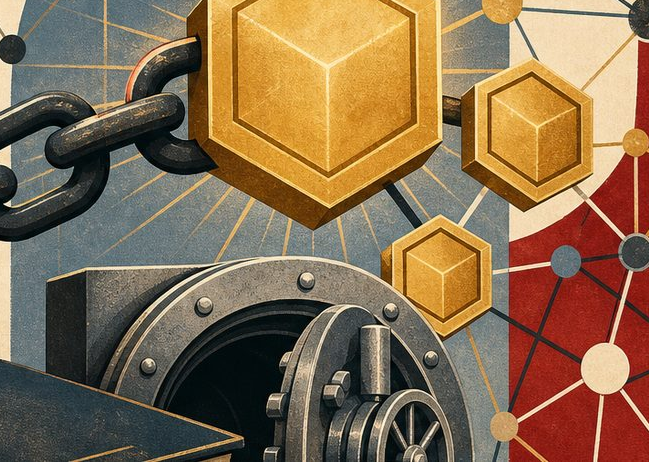
By The Same Token: Trump-linked WLFI faces investor revolt
The Situation
Trump-linked World Liberty Financial (WLFI) is facing an investor revolt after allegations that the project shipped (or planned) hidden control hooks enabling insiders to freeze tokenholder funds, pulling the governance dispute out of “DeFi drama” and into market-structure risk (Japan Times). The flashpoint is a $75M DeFi lending position and the team’s defense of its risk management—followed by an open feud with Justin Sun and threats of litigation (CoinDesk, CoinDesk). WLFI’s token sold off after the team defended the position, tightening the feedback loop between governance credibility and funding liquidity (CoinDesk).
For institutional readers, the relevance isn’t the headline name—it’s the pattern: projects trying to wear “serious finance” branding while embedding issuer-grade discretion (freeze/blacklist/upgrade powers) without institution-grade disclosure, controls, or recourse.
The Mechanism
- Control-plane risk is the product risk: If WLFI (or its admins) can freeze funds, tokenholders aren’t holding a bearer asset; they’re holding a revocable claim on a permissioned control surface—without the governance scaffolding banks use (policy, audit trails, segregation of duties).
- “DeFi loan” becomes a liquidity stress test: A large lending position concentrates liquidation, oracle, and collateral-quality risk. When governance is questioned, counterparties price in adverse admin action (freeze, parameter change, emergency upgrade) as a new form of haircut.
- Insider discretion ≠ regulated transfer restrictions: TradFi tokenization uses transfer controls (whitelisting, lockups) as disclosed compliance features. Here the allegation is undisclosed or secretly engineered controls—turning “programmability” into a governance attack vector.
- Counterparty mapping shifts from protocol to people: The core diligence question becomes: who holds admin keys, what is the upgrade path, what are the timelocks, and who can trigger “emergency” functions. That’s the same lens investors now apply to RWA issuers choosing between issuer-sponsored contracts and independent infrastructure.
- Reputation spillover hits bank pilots indirectly: High-profile “freeze” controversies harden compliance teams against public-chain integrations unless the product clearly separates (a) compliant transfer restrictions from (b) discretionary confiscation.
- Litigation threat signals governance breakdown: “See you in court” is a tell that disputes are migrating from on-chain resolution norms to off-chain enforcement, which increases jurisdictional and enforcement uncertainty for any capital adjacent to the project.
The State of Play
Market Position
WLFI is effectively attempting to straddle two worlds: the DeFi balance-sheet playbook (levered positions, rapid liquidity) and the institutional narrative (brand, legitimacy, implied guardrails). The investor revolt suggests that, absent credible constraints on insider power, markets will treat “admin controls” as credit risk—and demand either higher returns, harder guarantees, or they simply withdraw liquidity.
The broader market-structure takeaway for tokenization teams: the industry is converging on an uncomfortable truth—programmability is governance, and governance is now priced like a counterparty. The winners in RWAs and stablecoin infrastructure are the ones who can prove that control rights are (1) explicit, (2) bounded, and (3) independently overseen.
Regulatory Landscape
This hits Washington at a bad time. With the Clarity Act back on the Senate calendar, policymakers are already focused on drawing lines between commodities-like tokens, securities-like tokens, and the responsibilities of intermediaries (CoinDesk, CoinDesk). Allegations of stealth freeze controls hand regulators an easy narrative: “crypto needs the same control disclosures and fiduciary standards as traditional issuers,” especially when projects market themselves as finance-adjacent.
Expect enforcement and rulemaking attention to cluster around: (a) disclosure of admin/upgrade powers, (b) marketing representations about decentralization, and (c) whether tokenholder rights are effectively contractual claims governed by identifiable insiders.
Key Data
- $75M: size of the DeFi lending position at the center of the dispute (CoinDesk).
- Freeze capability alleged: investor claims of “controls that let insiders freeze token holders’ funds” (Japan Times).
- -12%: reported single-day token drop after the team defended its lending position (CoinDesk).
- Litigation escalation: WLFI publicly threatening legal action against Justin Sun as the dispute spills off-chain (CoinDesk).
What’s Next
The immediate catalyst is proof-of-control: either a credible third-party technical review (admin key architecture, upgradeability, timelocks, freeze/blacklist functions) or an on-chain governance change that constrains insiders in a way markets can verify. If WLFI can’t produce that quickly, liquidity providers will continue to treat it as an issuer-discretion risk trade, and the story will be used as fresh ammunition in D.C. as Senate staff re-open the question of what “customer protection” should mean for tokens that can be unilaterally constrained.
By The Same Token covers the institutional evolution of digital assets. For questions or tips: reply to this email.
🌐 Visit whatsthelatest.ai for the latest Digital Assets coverage and more.
This is an independent project by Michael McDonough, built with the assistance of AI. Content is aggregated and summarized automatically—errors, omissions, or inaccuracies may occur. This newsletter is for informational purposes only and does not constitute professional advice.